
 Farsi (فارسی)
 Kurdish (کُردی)

Child Sexual Abuse in Iran
Research on Child Sexual Abuse Within Families
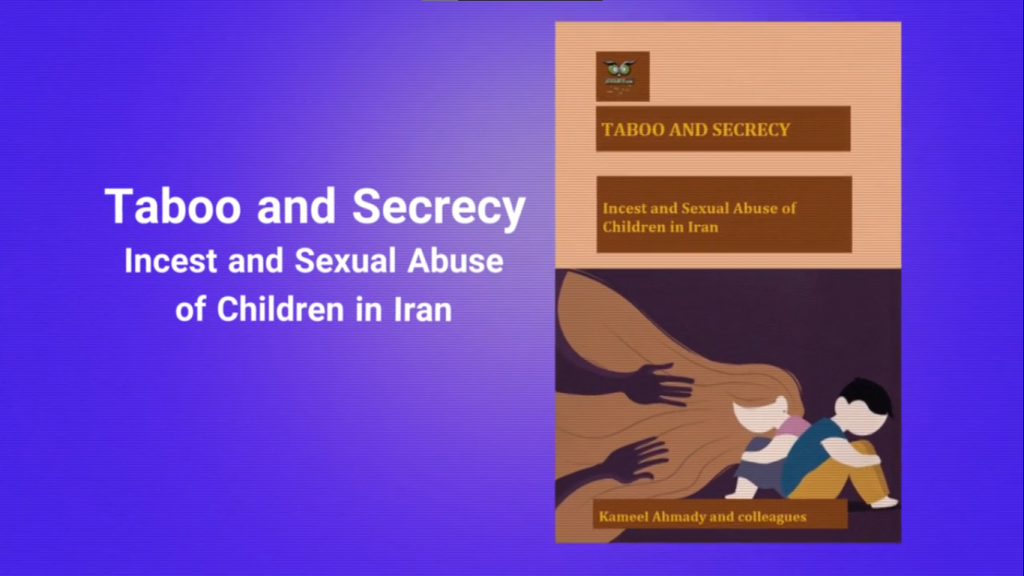
This page introduces Kameel Ahmady and colleagues’ research on child sexual abuse within family relationships in Iran. The related book, Taboo and Secrecy, examines accounts of abuse, barriers to disclosure and access to support.
Child sexual abuse is a form of child maltreatment. WHO places maltreatment within relationships of responsibility, trust or power and describes possible harm to children’s health, development and dignity. Its child maltreatment factsheet provides general public-health context; it is not a source for an Iranian prevalence estimate.
What the Research Examines
The research discusses secrecy, stigma, unequal power within families and institutional responses. Accounts collected in a study can help explain experiences and barriers to support. They should not be treated as a diagnostic checklist, proof that a particular family circumstance causes abuse, or a measure of prevalence across Iran.
Read findings alongside the methods and limitations of the specific publication. Interview counts, locations and editions should be identified from that publication rather than combined across related articles.
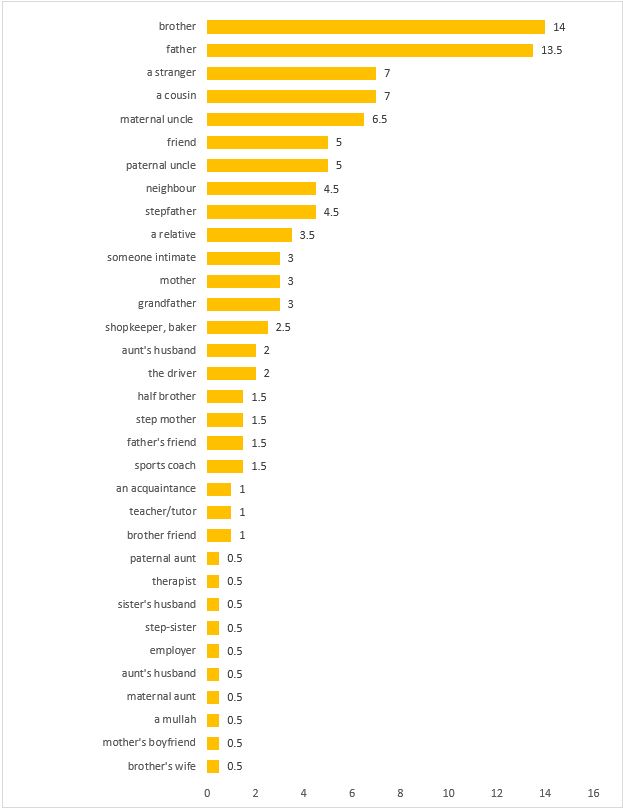
Text description and values: Relationship categories shown in the first figure
The image does not label its units or sample size. Values below reproduce the printed numbers without assigning a percentage or a population. Category wording is transcribed from the figure; it does not establish a clinical diagnosis or a causal finding.
| Label shown | Value shown (unit not specified) |
|---|---|
| brother | 14 |
| father | 13.5 |
| a stranger | 7 |
| a cousin | 7 |
| maternal uncle | 6.5 |
| friend | 5 |
| paternal uncle | 5 |
| neighbour | 4.5 |
| stepfather | 4.5 |
| a relative | 3.5 |
| someone intimate | 3 |
| mother | 3 |
| grandfather | 3 |
| shopkeeper, baker | 2.5 |
| aunt’s husband | 2 |
| the driver | 2 |
| half brother | 1.5 |
| step mother | 1.5 |
| father’s friend | 1.5 |
| sports coach | 1.5 |
| an acquaintance | 1 |
| teacher/tutor | 1 |
| brother friend | 1 |
| paternal aunt | 0.5 |
| therapist | 0.5 |
| sister’s husband | 0.5 |
| step-sister | 0.5 |
| employer | 0.5 |
| aunt’s husband | 0.5 |
| maternal aunt | 0.5 |
| a mullah | 0.5 |
| mother’s boyfriend | 0.5 |
| brother’s wife | 0.5 |
The label “aunt’s husband” appears twice with different values; both entries are retained. The image provides no explanation for the repetition.
Interpreting Experiences and Findings
The study considers how participants describe their relationships, wellbeing and encounters with services. Individual experiences vary. Broad lists of personality traits or symptoms cannot establish whether abuse occurred or identify a perpetrator. Sexual orientation should not be presented as a disorder or as evidence of abuse.
Responsibility for abuse rests with the person committing it. Children should not be blamed for silence, limited knowledge, dependence on adults or difficulty seeking help.
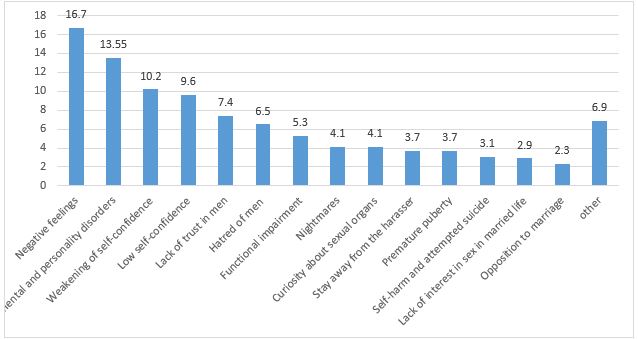
Text description and values: Experience and effect labels shown in the second figure
The image does not label its units or sample size. Values below reproduce the printed numbers without assigning a percentage or a population. Category wording is transcribed from the figure; it does not establish a clinical diagnosis or a causal finding.
| Label shown | Value shown (unit not specified) |
|---|---|
| Negative feelings | 16.7 |
| Mental and personality disorders | 13.55 |
| Weakening of self-confidence | 10.2 |
| Low self-confidence | 9.6 |
| Lack of trust in men | 7.4 |
| Hatred of men | 6.5 |
| Functional impairment | 5.3 |
| Nightmares | 4.1 |
| Curiosity about sexual organs | 4.1 |
| Stay away from the harasser | 3.7 |
| Premature puberty | 3.7 |
| Self-harm and attempted suicide | 3.1 |
| Lack of interest in sex in married life | 2.9 |
| Opposition to marriage | 2.3 |
| other | 6.9 |
Similar self-confidence labels remain separate as printed. The table does not reinterpret or combine them.
Prevention, Protection and Support
WHO describes prevention and response as work across several sectors, including support for caregivers, safe learning environments, education, protective laws and accessible services. These are general approaches; this page does not claim that any single intervention has been proven effective by this study.
The research recommendations should be read as proposals for discussion, with attention to the evidence and local context. This page is a research overview and does not provide an individual assessment or a verified directory of support services.
Related Publications
Use the existing article listings below to explore the research on family contexts, consequences and legal questions. For the book and its existing download links, visit Taboo and Secrecy.
References and Further Reading
- child maltreatment factsheet
- Kameel Ahmady, Taboo and secrecy.
This book is also available in Farsi and Kurdish. Follow the edition pages for publication and download details.
search
Articles
Related Content
About the Researcher
Kameel Ahmady is a British-Iranian researcher working in the field of social anthropology, with a particular focus on gender, children, ethnic minorities, and child labour. Kameel was born in Iranian Kurdistan (also known as East Kurdistan). He obtained his Master’s degree in Social Anthropology and Visual Ethnography from the University of Kent, UK. His academic pursuits include specialized courses in Middle Eastern Politics and Research Methods from other British institutions. Known for studying harmful traditions, Ahmady serves as both a supervisor and developer for his teamwork research publications in Farsi, Kurdish, and English. In 2017, he was honoured with “Honour” prize by the UK based IKWRO organization at the University of Law in London. Subsequently, in 2018, at George Washington University, Global P.E.A.C.E. foundation bestowed upon him the “Literature and Humanities” award in recognition of his contributions to the field. Among his group works are titles such as ” Conformity and Resistance in Mahabad,” ” Another Look at East and Southeast of Turkey,” “In the Name of Tradition,” “A House on Water,” “The Echo of Silence,” ” Traces of Exploitation in Childhood,” and more….
Articles



FAQ About Child Sexual Abuse
- What is the focus of this page?
Research on child sexual abuse within family relationships in Iran, including experiences described in the research and barriers to disclosure and support.
- Does this research establish a national prevalence rate?
This overview does not establish a national rate. Findings must be interpreted using the sample, methods and limitations of each publication.
- Can a checklist identify abuse or a perpetrator?
The proposed overview does not offer diagnostic or perpetrator profiles. It avoids treating individual traits, family circumstances or sexual orientation as proof of abuse.
- Who is responsible for preventing abuse?
Responsibility belongs to adults and institutions with duties to protect children. Children are not responsible for abuse or for being unable to disclose it.
- Where can I read the research?
Read the related articles on this page and the book Taboo and Secrecy. The existing book page provides publication details and download links.
Creating a safe and supportive environment for children, where they feel empowered to speak out against abuse and where perpetrators are held accountable, is essential in the fight against child sexual abuse.
Child sexual abuse can have profound and long-term effects on a survivor’s mental and emotional well-being, often necessitating therapeutic support and counseling.
Perpetrators of child sexual abuse can be known to the child, such as family members or trusted adults, making it even more challenging to detect and prevent.
What support services and therapeutic interventions are available to child survivors of sexual abuse, and how can we ensure their well-being and recovery?
Addressing child sexual abuse requires vigilant efforts in child protection, including awareness, education, and effective reporting mechanisms to help victims and prevent further abuse.
How can schools, communities, and institutions create safer environments for children to disclose abuse and prevent further victimization?