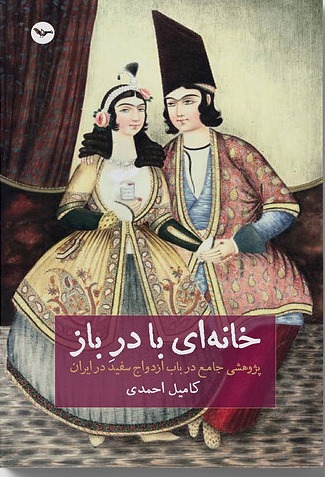
House with Open Door, by Kameel Ahmady and colleagues, examines cohabitation, often called ‘white marriage’ in Iran: living together without a formally registered marriage. It considers people’s experiences alongside economic conditions, changing values, cultural and religious expectations, and gender relations.
The book explores the gap between changes in everyday life and the norms that constrain people’s choices or make their experiences difficult to discuss. Its critical focus includes social pressure, secrecy, unequal power and access to support.
In-depth interviews, grounded theory and research scope
The study focuses on Tehran, Mashhad and Isfahan. In-depth interviews provided the research material, while grounded theory informed its analysis. These are distinct parts of the research: interviewing is a means of gathering accounts; grounded theory is an approach to developing concepts and explanations from the data.
The English book describes non-random recruitment in a setting where participants could be difficult to reach. Its findings should be read in the context of the participants, the fieldwork period and the limits of the method. Research in three cities does not, by itself, establish national prevalence or the views of everyone in Iran.
Economic pressures and changing values
The book examines employment, the cost of living, the expectations attached to formal marriage and changes in values and lifestyles. Questions about personal choice and bodily autonomy also form part of its discussion.
These themes need to be considered alongside the circumstances and accounts of participants. Reasons for cohabiting differ between people; attributing a single motive to every couple or to young people as a whole would flatten those differences.
Choice, inequality and the ability to speak
The research questions norms that make relationships outside accepted patterns difficult to describe or study. Family pressure, religious and cultural sensitivities, and fear of judgement can shape what people feel able to disclose.
Choice should be considered alongside economic dependence, bargaining power, security and access to support. Cohabitation cannot simply be described as a relationship without responsibilities or risks. The book examines how these concerns interact in the lives of participants.
Reading the findings and related research
This study develops questions connected with the author’s research on temporary marriage. For that work, see A House on Water. The two books address different relationship arrangements and should be read with attention to their separate research questions and samples.
Archived headlines about the duration of relationships, ages or participants’ characteristics should be checked against the original study period and calculation. A reported range is not a rule for every relationship or a current national estimate. A new publication or reprint date does not make all of its underlying data new.
Editions, languages and further reading
The English PDF linked as House-with-Open-Door.pdf identifies Mehri Publication, a 2021 imprint and ISBN 978-1-64945-722-6. Check the imprint in the particular file you use when citing the book, as edition details can differ.
English and Farsi PDFs and e-book listings are linked in the access section. For introductions in other languages, see the Farsi book page and Kurdish book page. Related background is available on the cohabitation topic page.
Common questions
What is House with Open Door about?
It examines cohabitation without formal marriage in Iran, exploring participants’ experiences and the social and economic circumstances around their relationships.
How were the data collected and analysed?
The book describes in-depth interviewing and a grounded-theory approach to analysis. The research focuses on Tehran, Mashhad and Isfahan.
Are the findings national or current estimates?
The sample and setting should be examined before generalising the findings. Figures and archived headlines need to be read with their original dates and definitions.
Which edition should I cite?
Use the title and imprint printed inside the edition you consulted. Different files may have different publication details and page numbers.
These reports belong to their original publication periods. Their headlines and figures do not establish current national statistics or the present legal position.
Essential cookies are active for the website to work. Visitor statistics and external content such as YouTube depend on your choice. You can accept or reject optional cookies, or choose your settings. You can change your choice through “Cookie settings”.
Essential
Always active
Essential storage needed to provide services and remember your cookie choice is always active.
Preferences
The technical storage or access is necessary for the legitimate purpose of storing preferences that are not requested by the subscriber or user.
Visitor statistics
This option allows Google Analytics to measure visits and use of the website.The technical storage or access that is used exclusively for anonymous statistical purposes. Without a subpoena, voluntary compliance on the part of your Internet Service Provider, or additional records from a third party, information stored or retrieved for this purpose alone cannot usually be used to identify you.
External content
This option allows external content such as YouTube to load. These services process information under their own policies.

 Farsi (فارسی)
 Kurdish (کُردی)